Words

Words

Every time, it’s a miracle. Here are all these people, full of heartache or hatred or desire, and we all have our troubles and the…year is filled with vulgarity and triviality and consequence, and…there’s this life we’re struggling through full of shouting and tears and laughter and fights and break-ups and dashed hopes and unexpected luck—it all disappears, just like that, when the choir begins to sing. Everyday life vanishes into song, you are suddenly overcome with a feeling of brotherhood, of deep solidarity, even love, and it diffuses the ugliness of everyday life into a spirit of perfect communion. Even the singers’ faces are transformed…I see human beings, surrendering to music.

Every time, it’s the same thing. I feel like crying, my throat goes all tight and I do the best I can to control myself but sometimes it gets close: I can hardly keep myself from sobbing. So when they sing a canon I look down at the ground because it’s just too much emotion at once: it’s too beautiful, and everyone singing together, this marvelous sharing. I’m no longer myself, I am just one part of a sublime whole, to which others also belong, and I always wonder at such moments why this cannot be the rule of everyday life, instead of being an exceptional moment during a choir.

When the music stops, everyone applauds, their faces all lit up, the choir radiant. It is so beautiful.

In the end, I wonder if the true movement of the world might not be a voice raised in song.

The Elegance of the Hedgehog, Muriel Barbery, 2006 (Translated from the French by Alison Anderson)

Words

Words

Empowerment refers to increasing the spiritual, political, social, or economic strength of individuals and communities. It often involves the empowered developing confidence in their own capacities.

  • The ability to make decisions about personal/collective circumstances
  • The ability to access information and resources for decision-making
  • Ability to consider a range of options from which to choose (not just yes/no, either/or.)
  • Ability to exercise assertiveness in collective decision making
  • Having positive-thinking about the ability to make change
  • Ability to learn and access skills for improving personal/collective circumstance.
  • Ability to inform others’ perceptions though exchange, education and engagement.
  • Involving in the growth process and changes that is never ending and self-initiated
  • Increasing one’s positive self-image and overcoming stigma
  • Increasing one’s ability in discreet thinking to sort out right and wrong

–Wikipedia, http://en.wikipedia.org/wiki/Empowerment, 27 September 2010

Would you change anything about  these statements regarding “empowerment”?

  • Seeing

    A progression of pots

    progression of pots

    On Saturday we visited the exhibit at the Arvada Center, Harencia Milenaria:  Contemporary Ceramics from Tonalá, Jalisco, México.   There were also two very dynamic collections of paintings.

    The work in this photo is called “Didáctica” by Barro Bruñido.

    I was reminded looking at these burnished pots of the developmental sequence and how the potter forms the clay…which pot are you?

    Words

    Words

    We cannot change the world by a new plan, project or idea. We cannot even change other people by our convictions, stories, advice and proposals, but we can offer a space where people are encouraged to disarm themselves, to lay aside their occupations and preoccupations and to listen with attention and care to the voices speaking in their own centre. How important it is to become empty in order that we may learn is well illustrated in the following Zen story:

    Nan-in, a Japanese master during the Meiji era (1868-1912), received a university professor who came to inquire about Zen.  Nan-in served tea.  He poured his visitor’s cup full, and then kept on pouring.  The professor watched the overflow until he could no longer restrain himself.  ‘It is overfull.  No more will go in!’  ‘Like this cup,’ Nan-in said, ‘you are full of your opinions and speculations.  How can I show you Zen unless you first empty  your cup?’

    To convert hostility into hospitality requires the creation of the friendly empty space where we can reach out to our fellow human beings and invite them to a new relationship.

    –Henri J. M. Nouwen, Reaching Out, 1975

    Reflecting · Seeing

    A nugget

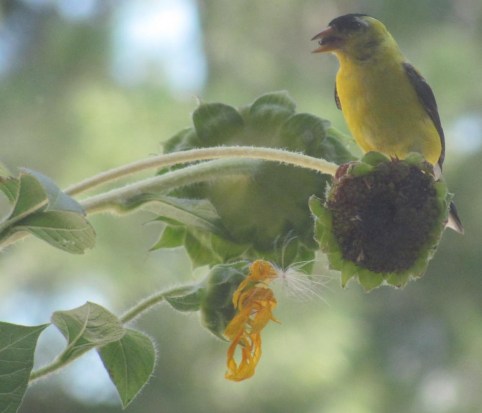
    Early this summer I took a handful of the sunflower seeds from the bag that I use to fill the bird feeder and dropped them into the dirt-filled flower pot next to the back door; in just a few days they sprouted. I wondered how tall the stalks might get as they seemed to head straight for the blue sky. Then the buds formed and the lanky stalks began to list groundward so I strung them to a stake. Everyday the thirsty plants demanded a gallon of water wilting pathetically as a visual reprimand if I neglected them. Now the flowers are packed with seeds identical to their siblings in the feeder, the leaves are yellowing and dropping to the deck; the plants have completed their life cycle.

    But wait…

    There is one last obligation in the circle of life–to tempt the creatures of the neighborhood with those tasty seeds in an effort to spread the gene pool. Success! Here are two visitors: a goldfinch crunching seeds in situ and a squirrel who prefers to nip the flowers from the stalk and escape to a distant post to consume the booty.

    goldfinch on sunflower

    squirrel eating sunflowers

    Words

    Words

    When we focus on clarifying what is being observed, felt, and needed rather than diagnosing and judging, we discover the depth of our own compassion.

    –Marshall B. Rosenberg, Nonviolent Communication:  A Language of Life, 2nd ed.

    Seeing

    Who knew this was possible?

    View Larger Map

    This is a Google Map of the home of Jacques Lacan, the famous French psychoanalyst. We stumbled upon this address when we were in Paris back in 2002 and were dumbfounded to see the plaque since husband was a big fan. He asked me this morning if we had a picture of the plaque and I thought I took a photo but despite many minutes of pawing around in boxes and photo album couldn’t put my hand on it. So, I tried Googling “Lacan plaque Paris”. The first link was on Wikimedia which showed the plaque (out of context) and the address; I then put the address into Google Maps…et voilà!! You can see where it is on the street, can zoom in to read the plaque, then continue walking down to where we stopped for coffee at a café. Hmmm, that’s the place I learned never to request a large coffee…it came in a cup the size of a mixing bowl! I’m betting the waiter is still laughing about l’americaine…

    Oh, you are asking why husband was wondering if we took a photo, it was for a blog post he was writing. An hour later, here I am…but I learned something new so it was all worth it!