Breathing in, I see myself as a flower. Breathing out, I feel fresh. During the time of breathing in you have to see yourself as a flower. We human beings, we are a variety of flower in the garden of humanity. Everyone of us, whether we are a gentleman or a lady. Every one of us has our flowerness that makes us beautiful, fresh, and pleasant.
—-Thich Nhat Hanh, on facebook 15 August 2010
Author: Anne Doyle
Spectacular views at Ghost Ranch
Morning at Ghost Ranch in New Mexico
At daybreak, the almost black clouds rolled behind the mesa like a sail being cranked down a mast. The sun eventually peeked over the edge after highlighting wisps of cloud into intense brilliance. The darkness drooped and light was shining again. But while it was too overwhelming to gaze upon, blinding in its spectacular emergence, the real story was in the opposite direction.
When I descended to the camp, I found a row of other spectators facing not to the east and the newly dawned fireball, but gazing to the west, watching the play of light upon the mountains in the distance, the hills in-between, the rolling plains. The light brought the greens to new life, to a fresh day. The blue sky cleared of haze and foggy wisps to become its own perfection.
Lesson: The story that morning was in what the light shone upon, not in the sun itself.
a new site, Transforming Health
I’ve started a new blog about health care, Transforming Health. There I plan to post news regarding health care, especially for the underserved, in Boulder, Colorado, and the nation. This is a part of my self-initiated research project to learn more about what is offered and where there are gaps. I will describe some of the current services offered and some innovations that might be beneficial to our community.
Please visit the site and refer it anyone you think might find it of interest. Thank you!
Words
“…before we speak, we can choose silence and then look honestly at what the urge to speak is telling us about ourselves.”
—Norvene Vest, No Moment Too Small, 1994
Intense color
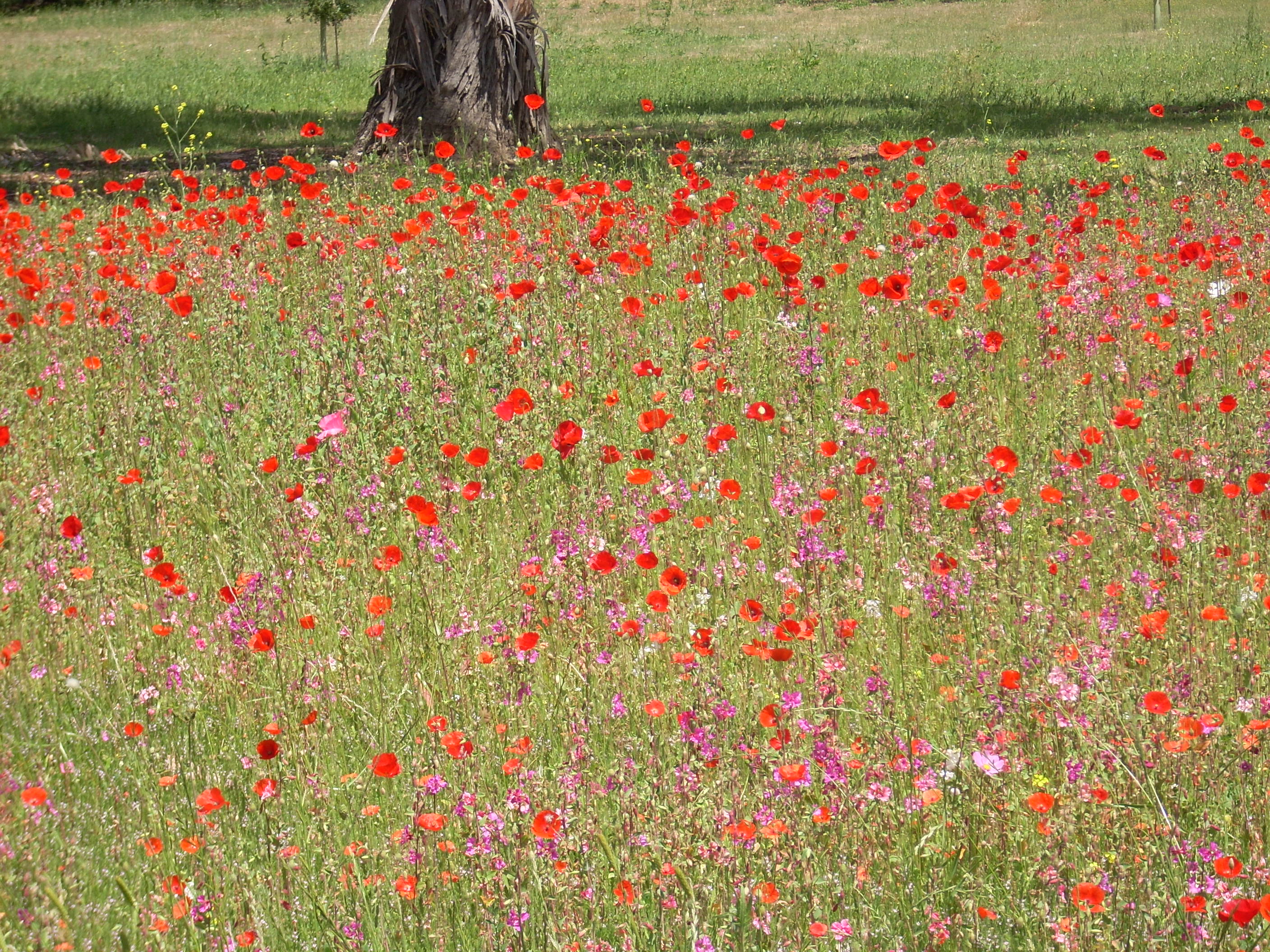
These are poppies on the campus of Stanford University but they are also powerful memory triggers. When I walked up on this field, I gasped remembering the fields and roadsides of France wheres splotches of bright red sprang up from the most surprising places…looking at them was like looking at joy.
A messsage?
Compelling
The New Guinea Sculpture Garden at Stanford University, created by ten master carvers from the Middle Sepik River Region of Papua New Guinea in the summer of 1994. “The project is not an attempt to recreate a traditional New Guinea environment but, according to Mason [the project director], ‘an opportunity to experiment with and reinterpret New Guinea aesthetic perspectives within the new context of a Western public art space.’ ” Read more here.
Stretching beyond what is comfortable
The first of the season
Words
“When we were young, we were told that poetry is about voice, about finding a voice and speaking with this voice, but the older I get I think it’s not about voice, it’s about listening and the art of listening, listening with attention. I don’t just mean with the ear; bringing the quality of attention to the world. The writers I like best are those who attend.”
–Kathleen Jamie, Scottish poet born on this date in 1962
New kid on the block
This flowering cherry tree was planted just yesterday. The cottonwood stump looming in the background was cut down on 12 February. Wouldn’t it be a little intimidating to stand next to that reminder of greatness? Doesn’t it seem like a harbinger of doom? Fortunately, they plan to remove the stump soon.
I continue to mourn the loss of that big tree and feel sad for the displaced birds and squirrels. How long will it take for the leaves of that flowering cherry to rustle in the breeze and sing me back to sleep when I awaken in the night?
Still, it’s a welcome addition to the ‘hood…now GROW!
Words
More from The Healing of America by T.R. Reid (p.87):
Everyone in Japan is required to sign up with a health insurance plan. This is a “personal mandate,” an issue that became controversial during the 2008 presidential election in the United States. Every nation that relies on health insurance has that requirement (except the USA), and in Japan the mandate is not controversial at all. “It’s considered an element of personal responsibility, that you insure yourself against health care costs,” Dr. Ikegami (the country’s best-known health care economist) told me [T.R. Reid]. “And who can be against personal responsibility?”
Does it snow every day?
It certainly seems so. Under these buckets are three pepper plants and one tomato that my enthusiastic neighbor bought and planted in our little garden space. Alas, the pepper leaves have all dropped off leaving only bare stalks to bear this cold and the top leaves of the tomato have blackened like a face with frostbite. I fear we will have to start again, but I feel responsible for these fragile beings while they still stand.
More Words on health care
Another quote from T. R. Reid’s The Healing of America: A Global Quest for Better, Cheaper, and Fairer Health Care:
“…it seems certain that the French will continue to emphasize equal access to medical care–the basic rule that anybody, regardless of race, income, or occupation, can go to any doctor and get the same treatment as anybody else. Whenever the French talk about health care, they invoke the concept of solidarité, the notion that all French citizens must stick solidly together to help one another in time of need. ‘The solidarity principle, explains Professor Rodwin, “requires mutual aid and cooperation among the sick and the well, the inactive and the active, the poor and the wealthy, and insists on financing health insurance on the basis of ability to pay, not actuarial risk.’
A French physician, Dr. Valerie Newman, put the same idea a little more bluntly when I asked her why the French system is so focused on free access to any doctor or hospital. ‘It would be stupid to say that everybody is equal,’ she began. ‘Some are rich and some are poor. Some are beautiful, some aren’t. Some are brilliant, some aren’t. But when we get sick–then, everybody is equal. Everybody must have equal right to the best medical treatment we can provide.’ Now Dr. Newman was excited as she rose to her rhetorical climax. ‘That is the basic rule of French health care,’ she said. ‘Surely, that’s the basic rule of health care in every country.’
Well, not quite. Equal access for all is the basic rule of health care in almost every developed country–but not the United States.” (pp. 64-65)