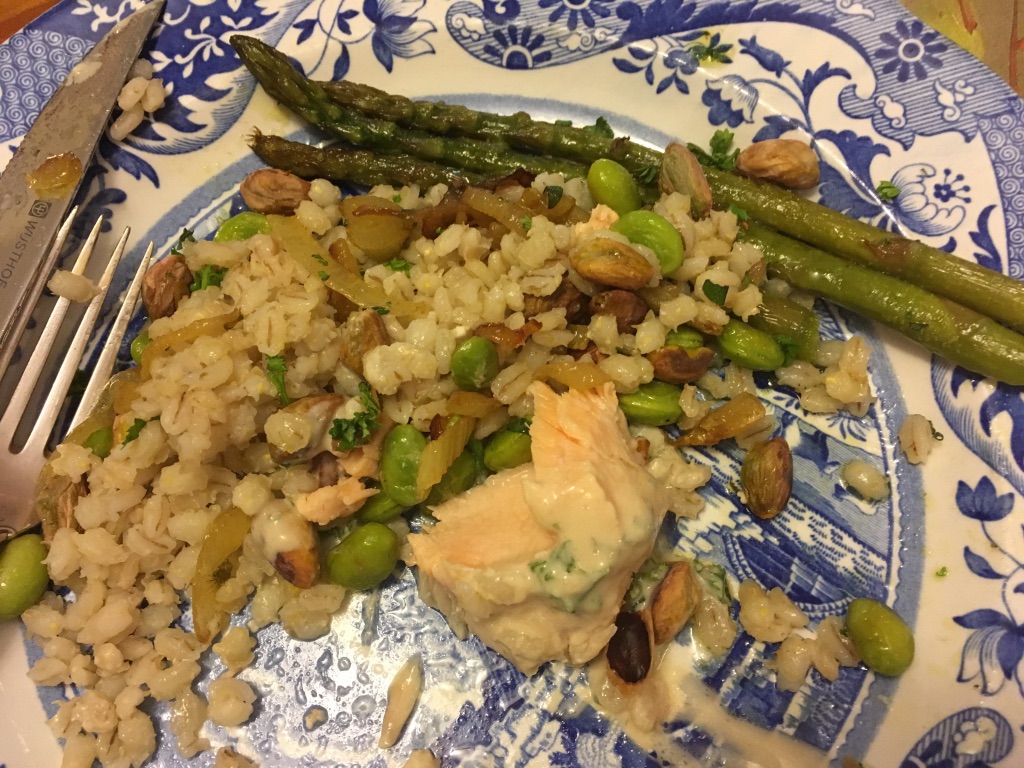
J cooked mahi mahi sautéed in butter with lemon, sautéed vegetables including pineapple, rice

J cooked mahi mahi sautéed in butter with lemon, sautéed vegetables including pineapple, rice

K cooked; chicken, coconut milk, red curry, sweet peppers, bamboo shoots, cilantro and rice
Snoozy day

Things are a little messy currently on my blog–sorry! I am finding some duplication of posts and pages as well as the reappearance of the occasional old news resurfacing; funny things happen sometimes when you move content to a new location. I hope to tidy things up so the past posts are more accessible.
WILD GEESE
You do not have to be good.
You do not have to walk on your knees
for a hundred miles through the desert, repenting.
You only have to let the soft animal of your body
love what it loves.
Tell me about despair, yours, and I will tell you mine.
Meanwhile, the world goes on.
Meanwhile the sun and the clear pebbles of the rain
are moving across the landscapes,
Over the prairies and the deep trees,
the mountains and the rivers.
Meanwhile the wild geese, high in the clean blue air
are heading home again.
Whoever you are, no matter how lonely,
the world offers itself to your imagination,
calls to you like the wild geese, harsh and exciting —
over and over announcing your place
in the family of things.
With a perspective on welcoming the different parts of yourself by Patty de Llosa here.
I posted this back on June 1, 2014. When I read it again today, I was moved to post it here not remembering that I had done so then. It must resonate still…
For the world and time are the dance of the Lord in emptiness. The silence of the spheres is the music of a wedding feast. The more we persist in misunderstanding the phenomena of life, the more we analyze them out into strange finalities and complex purposes of our own, the more we involve ourselves in sadness, absurdity and despair. But it does not matter much, because no despair of ours can alter the reality of things; or stain the joy of the cosmic dance which is always there. Indeed, we are in the midst of it, and it is in the midst of us, for it beats in our very blood, whether we want it to or not.
Yet the fact remains that we are invited to forget ourselves on purpose, cast our awful solemnity to the winds and join in the general dance.
–Thomas Merton, New Seeds of Contemplation.
Above all, trust in the slow work of God.
We are quite naturally impatient in everything
to reach the end without delay.
We should like to skip the intermediate stages.
We are impatient of being on the way to something
unknown, something new.
And yet it is the law of all progress
that it is made by passing through
some stages of instability—
and that it may take a very long time.
And so I think it is with you;
your ideas mature gradually—let them grow,
let them shape themselves, without undue haste.
Don’t try to force them on,
as though you could be today what time
(that is to say, grace and circumstances
acting on your own good will)
will make of you tomorrow.
Only God could say what this new spirit
gradually forming within you will be.
Give Our Lord the benefit of believing
that his hand is leading you,
and accept the anxiety of feeling yourself
in suspense and incomplete.
From Joan Chittister email series, visionviewpoint at benetvision dot org, on January 20, 2015.
How to do nonviolent resistance
Nonviolent resistance, derived from Mahatma Gandhi and modeled in this country by Martin Luther King, Jr.’s civil-rights movement of the sixties, rests on six clear concepts, none of them cowardly, insipid or weak. They are, rather, a demonstration of the kind of strength no amount of violence can extinguish.
First, nonviolent resistance is pacifism, not passivism. The difference between armed resistance and nonviolent resistance lies simply in the means by which the resistance is waged. Both types of resistance rest on the conviction that evil must be challenged, but nonviolent resistance insists that evil must not be repeated in the effort to defeat it. The strength of nonviolent resistance lies in its determination to do no harm to the other in the course of resisting harm. Gandhi wrote, “If there is blood in the streets, it must be no one’s but our own.”
Second, nonviolent resistance is committed to making friends out of enemies. The goal of nonviolent resistance is to concentrate on issues rather than on belittling, demeaning, destroying the people who hold positions different from our own. Nonviolent resistance calls us to distinguish between enmity and opposition.
Third, nonviolent resistance condemns systems, ideas or policies that oppress but never launches personal attacks against individuals who are the agents of the system itself. If we cannot assume the good will of those who oppose us we must at least not judge their motives. Ideas and systems are bigger than any single person. To attack individuals in order to curb a sinful system only plays into the hands of the system itself by failing to focus attention where attention is necessary.
Fourth, nonviolent resistance absorbs physical attack without striking back physically. Suffragettes went to jail to win the vote and never struck a blow. Women and men faced attack dogs in Selma, Alabama, to win the right to be human beings without themselves becoming barbaric in the process. It was row upon row of Indians falling to their knees under the gratuitous blows of their English masters that sent a chill up the spine of a colonial world. Nonviolent resistance unmasks the inhumanity of oppression and gives all of us another chance to repent and begin again to be thinking, feeling human beings.
Fifth, nonviolent resistance refuses to sow hate for the enemy. Hate gives foundation to hate until hate becomes a cycle that never ends. Nonviolence vows not only to end the oppression but to end the hate as well. “Love your enemy” is not poetry; it is strategy. Those we want to have love us, we will have to love first.
Sixth, nonviolent resistance is based on the faith that in the end justice will come because justice is right and God is good. Two commandments undergird nonviolence and ring in every heart: The first is “Love your neighbor as yourself,” and the second is “Vengeance is mine,” says the Lord. “I will repay.” Love is our responsibility. Justice is God’s.
Each of these principles taxes courage, demands great spirituality and promises opposition equal to the length of the struggle and the depth of the issue.
—from Heart of Flesh: a feminist spirituality for women and men, by Joan Chittister (Eerdmans), reprinted in Joan Chittister: Essential Writings, ed. Mary Lou Kownacki and Mary Hembrow Snyder (Orbis).
This article says a lot of what I am thinking now. Amazing to find the words of another that so resonate. Thanks to Brian McLaren for posting a link on Facebook.
From Jennifer Michael Hecht’s book “Stay”:
“None of us can truly know what we mean to other people, and none of us can know what our future self will experience. History and philosophy ask us to remember these mysteries, to look around at friends, family, humanity, at the surprises life brings — the endless possibilities that living offers — and to persevere. There is love and insight to live for, bright moments to cherish, and even the possibility of happiness, and the chance of helping someone else through his or her own troubles. Know that people, through history and today, understand how much courage it takes to stay. Bear witness to the night side of being human and the bravery it entails, and wait for the sun. If we meditate on the record of human wisdom we may find there reason enough to persist and find our way back to happiness. The first step is to consider the arguments and evidence and choose to stay. After that, anything may happen. First, choose to stay.”
Read the final chapter here and listen to Krista’s interview with the philosopher-poet here.
One day you finally knew
what you had to do, and began,
though the voices around you
kept shouting
their bad advice–
though the whole house
began to tremble
and you felt the old tug
at your ankles.
“Mend my life!”
each voice cried.
But you didn’t stop.
You knew what you had to do,
though the wind pried
with its stiff fingers
at the very foundations,
though their melancholy
was terrible.
It was already late
enough, and a wild night,
and the road full of fallen
branches and stones.
But little by little,
as you left their voices behind,
the stars began to burn
through the sheets of clouds,
and there was a new voice
which you slowly
recognized as your own,
that kept you company
as you strode deeper and deeper
into the world,
determined to do
the only thing you could do–
determined to save
the only life you could save. – Mary Oliver
You Reading This, Be Ready
by Wllliam Stafford
Starting here, what do you want to remember?
How sunlight creeps along a shining floor?
What scent of old wood hovers, what softened
sound from outside fills the air?
Will you ever bring a better gift for the world
than the breathing respect that you carry
wherever you go right now? Are you waiting
for time to show you some better thoughts?
When you turn around, starting here, lift this
new glimpse that you found; carry into evening
all that you want from this day. The interval you spent
reading or hearing this, keep it for life—
What can anyone give you greater than now,
starting here, right in this room, when you turn around?
As read here in an article by Parker Palmer.